
The label on the bat says “-10” and the salesperson just nodded like you both know what that means. Drop weight is one of the most important bat specs — and one of the least explained. Get it wrong and you’re either leaving exit velocity on the table or handing your kid a bat they can’t get through the zone with.
Drop weight is the numerical difference between a bat’s length in inches and its weight in ounces. A 33-inch bat weighing 30 ounces has a drop weight of -3. A 30-inch bat weighing 20 ounces is a -10 drop. The higher the negative number, the lighter the bat swings relative to its length.
What Is Drop Weight?
Drop weight is the numerical difference between a bat’s length in inches and its weight in ounces. A 33-inch bat weighing 30 ounces has a drop weight of -3. Higher negative numbers indicate a lighter bat relative to its length; lower numbers indicate a heavier bat.
Drop weight = length (inches) − weight (ounces). That’s it. A 30-inch, 20-ounce bat: 30 − 20 = -10. A 33-inch, 30-ounce bat: 33 − 30 = -3.
The number tells you how light or heavy a bat swings relative to its length. A -12 drop is noticeably lighter than a -8 drop of the same length. A -3 drop is the heaviest option available at the high school and college level — BBCOR certification locks every high school and college bat at -3, no exceptions.
Here’s the quick mental model: higher negative number = lighter bat. Lower negative number = heavier bat. A -3 is heavier than a -10. A -13 is lighter than a -10. Players who lose track of this get confused because the numbers look backwards — just remember that -3 is “only 3 apart,” which means heavy, and -13 is “13 apart,” which means light.
The practical side: swing weight changes with drop. A player moving from a -10 to a -5 is picking up meaningful bat mass. Their mechanics need to adjust. This is why the USSSA-to-BBCOR transition trips up so many players — more on that below.
Drop Weight by Certification — What the Rules Actually Require
Drop weight isn’t just a fitting tool. It’s regulated. Different certifications enforce different limits, which is why a bat that’s legal in one league is illegal in another.
BBCOR (High School and College): Every BBCOR bat must be a -3 drop. No exceptions. If a bat says BBCOR on the barrel, it’s a -3. BBCOR certification → also controls the bat-ball performance factor, but -3 is the hard floor for drop weight. The NFHS rules mandate this for all high school and college competition — you’ll never see a -5 BBCOR bat.
USSSA (Travel Ball, Most Youth Leagues): USSSA bats typically run from -5 to -10 for baseball, with some youth bats going to -12. No single drop weight is locked in — leagues and age groups set their own limits. Check your specific league rulebook. Most 12U and under travel ball players use -10; 13U/14U players often move to -8 or -5 depending on their strength and league rules.
USA Baseball (Little League, Recreation Ball): USA bats range from -9 to -13.5. The USABat standard focuses on bat performance (same exit-velocity standard as wood), not a specific drop weight. Most recreational players in 8U–12U land in the -10 to -12 range. See the USSSA vs USA Baseball comparison → for the full certification breakdown if you’re trying to figure out which certification applies to your league.
Drop Weight Reference Table by Age
This table is a starting point. Individual player size and strength matter — a big, strong 10-year-old may be ready for a -8, while a smaller 12-year-old might still be better served by a -10. Use this as the default; adjust for your player.
| Age Group | Common Drop | Certification | Notes |
|---|---|---|---|
| 4–6U | -12 to -13.5 | USA / Tee Ball | Lightest available — bat speed development |
| 7–8U | -10 to -12 | USA | Starting to develop swing mechanics |
| 9–10U | -10 to -11 | USA | Standard starting point for most players |
| 11–12U | -8 to -10 | USA or USSSA | Travel ball → USSSA opens up here |
| 12–13U | -8 to -10 | USSSA | Most travel leagues use -10; stronger players try -8 |
| 13–14U | -5 to -8 | USSSA | Stronger players push toward -5 |
| HS Freshman | -3 to -5 | BBCOR or USSSA | Begin BBCOR prep if entering JV/Varsity |
| HS / College | -3 only | BBCOR | Locked — no other drop permitted |
For the full length-by-height and weight chart, see our baseball bat sizing chart →. That guide pairs drop weight recommendations with physical measurements and gives you a combined size-plus-drop lookup.
Drop Weight and Player Type — This Is the Part Everyone Gets Wrong
Here’s where most drop weight guides leave money on the table: they tell you that lighter is easier to swing, hand you an age chart, and call it done. That’s not wrong — but it misses the most important part. Lighter does not automatically mean better. It depends on what kind of hitter you are.
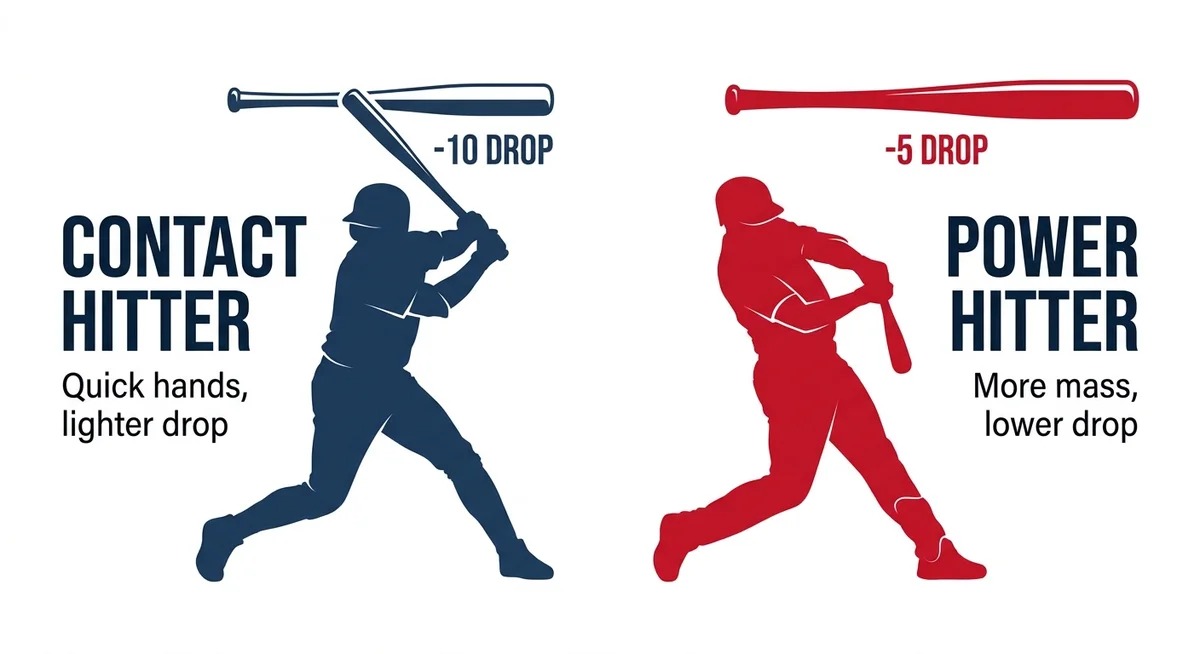
Contact hitters rely on quick hands, bat speed, and making consistent contact. A lighter bat (-10, -11, -12) helps them get through the zone faster, which means more contact opportunities and less swing-and-miss. Going heavier works against their strength.
Power hitters are swinging for exit velocity. They have the strength to handle heavier bat mass and the mechanics to drive through the ball. A power hitter who goes too light — chasing bat speed — often loses the weight behind the contact point that was generating their best hits. A -5 or -8 in the right hands hits harder than a -10 in the same hands.
Here’s the piece most guides skip entirely: one-piece bats are not a lightweight option for contact hitters. One-piece construction — whether alloy or composite — transmits more vibration on mishits (hand sting). A lighter one-piece still stings on off-center contact. Contact hitters who want a light, comfortable bat should be in a two-piece or three-piece composite at the drop that suits their age, not a one-piece alloy just because the sticker says it’s balanced. The bat sizing and player-type selection guide → breaks this down in full, including how construction and drop weight interact by player type.
What Happens When You Use the Wrong Drop?
Getting drop weight wrong doesn’t just affect performance — it can mess with mechanics.
Too light for your strength: Power hitters swinging a -12 don’t have enough bat mass to drive the ball. They make contact, the bat gives, and the ball doesn’t carry. This is common in youth travel ball when parents buy the lightest bat available because “he can swing it.” He can swing it, but he can’t drive it.
Too heavy for your size: Players who can’t control the bat through the zone start dropping their back shoulder, lunge at pitches, or sell out for contact and lose plate coverage. You’ll also see more hand sting — when a player is muscling a too-heavy bat, off-center hits feel worse. This is the bigger problem at the youth level. When in doubt, go lighter rather than heavier for younger and smaller players.
The transition shock: Players moving from -10 USSSA to -3 BBCOR in one step are dealing with a swing-weight jump that genuinely requires mechanical adjustment. It’s not just “this bat feels heavier.” The timing is different, the barrel lag is different, the hand position through the zone changes. The players who handle it best are the ones who started transitioning at -5 before they picked up a BBCOR bat.
How to Pick Your Drop Weight
The age table above gives you the starting point. Apply these to your situation:
Final Thoughts
Drop weight affects everything from swing speed to bat control to how much your hands sting when you foul one off. There is no single right answer — it depends on your certification, age, size, and what kind of hitter you are.
The age table points you in the right direction. The player-type section tells you when to adjust from it. And when you’re ready to match drop weight with the right bat length, the baseball bat sizing chart → gives you the complete picture.
Frequently Asked Questions
What does drop weight mean on a baseball bat? ⌄
Drop weight is the difference between a bat’s length in inches and its weight in ounces. A 33-inch, 30-ounce bat is a -3 drop. A 30-inch, 20-ounce bat is a -10 drop. Higher negative numbers mean a lighter bat relative to its length.
What drop should a 12-year-old use? ⌄
Most 12-year-olds in USA Baseball use a -10. Players in USSSA travel ball at 12U typically use -8 to -10 depending on league rules and the player’s size. Stronger 12-year-olds who are moving into 13U/14U travel ball can begin testing -8 drops.
What is a drop 3 bat? ⌄
A drop 3 bat is any bat with a -3 drop weight — meaning the bat weighs 3 ounces less than its length in inches. BBCOR certification requires all high school and college bats to be -3 drops. It is the heaviest drop weight in standard play.
Does drop weight affect performance? ⌄
Yes. A lighter drop gives players faster bat speed and more contact opportunities, but less mass behind the barrel. A heavier drop provides more driving force on contact for players with the strength to control it. The right drop depends on your player type and mechanics, not just your age.
What drop weight is required for BBCOR? ⌄
BBCOR requires exactly -3. Every BBCOR-certified bat is a -3 drop — no exceptions. This applies to all high school and college baseball governed by the NFHS and NCAA. BBCOR certification → also controls the bat performance factor separately from the drop weight requirement.