
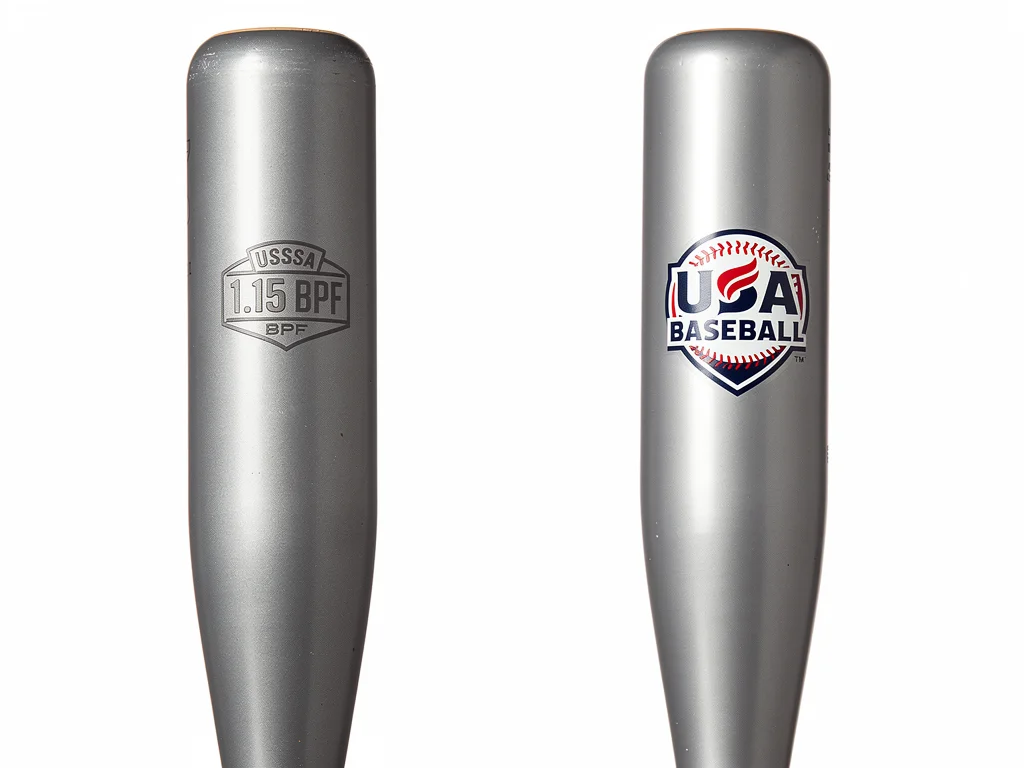
Two bats on the rack. One says “USA Baseball” on the barrel. The other says “USSSA 1.15 BPF.” They’re the same length, same drop weight, made by the same brand — and one is illegal in your kid’s league. The stamps look like they mean something, but neither one explains what it actually means for the bat your kid is about to swing. This USSSA vs USA baseball breakdown fixes that.
Here’s the short version: USSSA bats are for travel ball. USA Baseball bats are for Little League and rec leagues. They are not interchangeable. A USSSA bat used in a USA Baseball league will get your kid pulled from the game — and the performance difference between the two certifications is significant enough that it matters even before the umpire checks.
A USSSA bat meets the 1.15 BPF (Bat Performance Factor) standard set by USSSA for youth travel baseball leagues. It allows a higher trampoline effect than USA Baseball bats, producing 4–8 mph greater exit velocity — and is identified by the “USSSA 1.15 BPF” stamp on the barrel.
USSSA vs USA — The Differences That Matter
This is the comparison nobody lays out clearly. Same bat model, two certifications, completely different performance characteristics.
| Spec | USSSA | USA Baseball |
|---|---|---|
| Performance Standard | 1.15 BPF (Bat Performance Factor) | Wood-like performance cap |
| Max Barrel Diameter | 2¾ inches | 2⅝ inches |
| Allowed Drop Weights | -5 to -12 (age-dependent) | -5 to -12 (age-dependent) |
| Typical Exit Velocity | 4–8 mph higher than USA | Baseline (designed to match wood) |
| Sweet Spot | Larger (bigger barrel + higher BPF) | Smaller (performance-capped) |
| Stamp to Look For | “USSSA 1.15 BPF” or “NTS Tested” | “USA Baseball” logo |
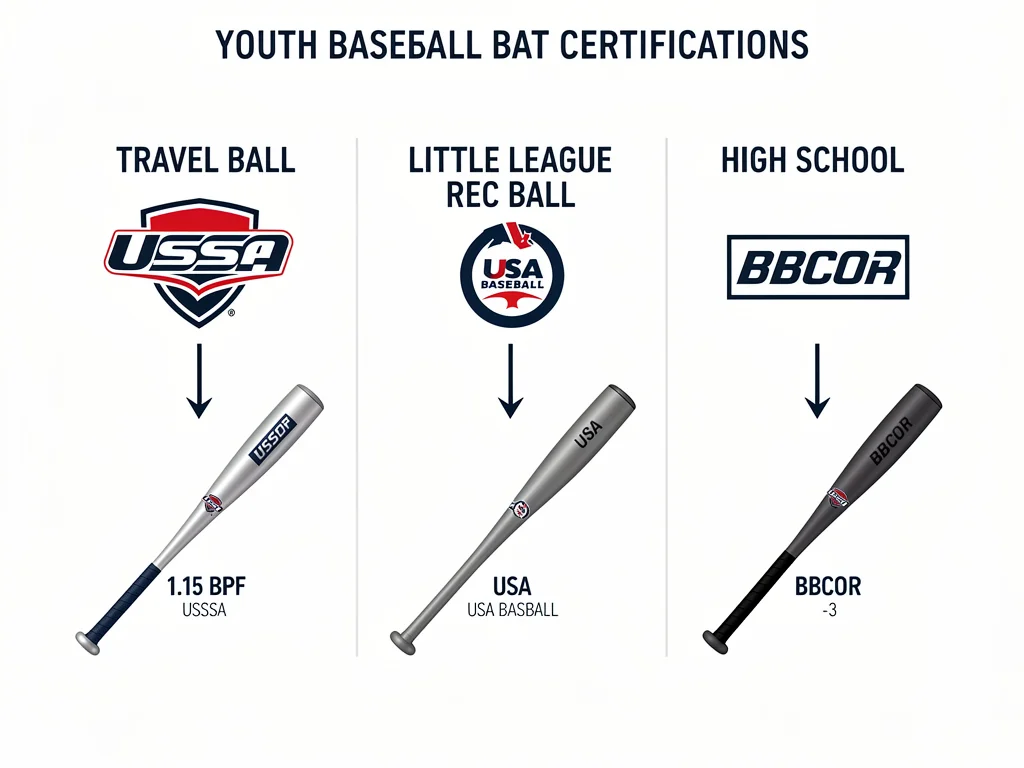
| Used In | Travel ball, USSSA tournaments | Little League, rec leagues, school programs |
| Cross-League Legal? | Not legal in USA Baseball leagues | Legal in USSSA but underperforms |
The NTS Tested stamp: Newer USSSA bats carry an additional “NTS Tested” mark, indicating they passed the updated National Testing System standard. Both the traditional “USSSA 1.15 BPF” stamp and the NTS Tested stamp are legal in USSSA play — they test to the same performance ceiling.
Reading the table: The biggest practical difference is exit velocity. A USSSA bat produces measurably more pop than a USA bat of the same length and drop. That’s by design — USA Baseball specifically capped performance to keep youth ball closer to wood-bat outcomes. USSSA didn’t impose that cap.
Which Leagues Use Which Certification?
This is the question that actually matters. Forget the specs — what stamp does your kid’s league require?
| League / Organization | Required Certification | Notes |
|---|---|---|
| Little League (Majors and below) | USA Baseball | USABat standard mandatory. BBCOR also accepted at Intermediate (50/70) and Junior divisions. |
| Little League (Intermediate/Junior) | USA Baseball or BBCOR | Both accepted. USSSA still not legal. |
| Cal Ripken / Babe Ruth | USA Baseball | Same as Little League — USA stamp required for youth divisions. |
| USSSA Travel Ball | USSSA 1.15 BPF | Check specific tournament rules — national events may have tighter restrictions. |
| PONY Baseball | USA Baseball | USA stamp required for youth divisions. |
| AAU Baseball | Varies by tournament | Some accept USSSA, some require USA. Always check specific event rules. |
| Rec / Municipal leagues | Usually USA Baseball | Most local rec leagues follow the USA Baseball standard. Confirm with your league director. |
| High School (NFHS) | BBCOR -3 only | Neither USSSA nor USA bats are legal at the high school level. |
The umpire checks bat stamps at the plate. If your kid steps up with a USSSA bat in a USA Baseball league, the at-bat is voided and the player may be ejected. Some tournaments do pre-game equipment checks. It’s not a gray area — wrong stamp means the bat doesn’t play.
Can You Use a USSSA Bat in Little League?
No. A USSSA bat is not legal in Little League or any USA Baseball-sanctioned league. The performance standards are different — USSSA bats produce significantly more exit velocity than the USA Baseball standard allows, which is exactly why the certifications exist as separate standards.
The reverse is technically possible but doesn’t make sense: a USA bat is legal in some USSSA leagues (check local rules), but it will underperform compared to USSSA-certified bats. You’re bringing a wood-like performer to a league that allows hotter bats — your kid is at a competitive disadvantage.
Bottom line: If your kid plays Little League, buy a USA bat. If your kid plays USSSA travel ball, buy a USSSA bat. Don’t try to use one for both.
Performance Differences — Why USSSA Bats Hit Harder
The 4–8 mph exit velocity gap between USSSA and USA bats isn’t marketing — it’s physics built into the certification standards.
BPF (Bat Performance Factor): USSSA allows a 1.15 BPF, meaning the ball comes off the barrel 15% faster than it would off a rigid surface. USA Baseball doesn’t publish a BPF number — instead, it caps performance to mimic wood bats. The practical result: a USSSA bat’s barrel has more trampoline effect. Same swing, same pitch, more ball speed off the bat.
Barrel diameter: USSSA bats allow 2¾-inch barrels. USA bats cap at 2⅝ inches. A larger barrel means a physically larger sweet spot — more surface area where contact produces solid hits. For developing hitters still working on their timing, that extra ⅛ inch of barrel is genuinely meaningful.
What this means for your kid: If your 10-year-old switches from a USA bat to a USSSA bat (because they moved from rec ball to travel ball), expect noticeable performance improvement without changing anything about their swing. The bat is doing more work. If they switch the other direction — travel ball to rec ball — expect an adjustment period. The USA bat will feel deader by comparison.
Drop Weight Rules by Certification
Drop weight is the difference between a bat’s length (inches) and weight (ounces). A 30-inch bat weighing 20 oz is a -10 drop. Both certifications allow similar drop weight ranges, but the bat performance at the same drop weight is different because of the BPF gap.
| Age Group | USSSA Drop Range | USA Baseball Drop Range | Notes |
|---|---|---|---|
| 7U–8U | -12 to -13 | -10 to -12 | Lightest possible in both — swing speed matters most |
| 9U–10U | -10 to -12 | -10 to -11 | -10 is standard for most players at this age |
| 11U–12U | -8 to -10 | -8 to -10 | Stronger players trending toward -8 |
| 13U–14U | -5 to -10 | -5 to -10 | USSSA nationals tighten: 13U caps at -5 |
| 14U (national) | BBCOR -3 (2026 rule) | N/A | USSSA national 14U now requires BBCOR -3 |
For a full breakdown of how to match bat length and drop weight to your player’s size, see the bat sizing and player selection guide →
The BBCOR Transition — When USSSA Ends
Both USSSA and USA certifications are youth standards. They end when your kid reaches high school — and the jump to BBCOR is the biggest equipment transition in baseball.
BBCOR -3 is the only legal bat in high school, college, and JUCO play. No exceptions. Every BBCOR bat weighs within 3 ounces of its length — a 33-inch bat weighs 30 oz. That’s a massive weight increase from the -8 or -10 bats your kid has been swinging.
Effective January 1, 2026, USSSA national 14U competition requires BBCOR -3 or wood only. This doesn’t affect most local leagues or regular-season USSSA play, but if your team travels to nationals, the transition starts now — not at 9th grade tryouts.
How to prepare: Any 13U or 14U player planning to play high school baseball should start taking batting practice with a BBCOR bat. The weight adjustment takes a full season to adapt. Players who wait until freshman year tryouts to touch a BBCOR bat are behind every teammate who started early.
For a full breakdown of BBCOR certification standards, barrel specs, and what makes a BBCOR bat legal, see our What Is BBCOR guide →
If You Play Both Leagues (The Two-Bat Problem)
Here’s the situation nobody talks about: a lot of kids play rec ball (USA) and travel ball (USSSA) at the same time. Spring rec league on weekdays, USSSA tournaments on weekends. Same kid, same swing, two completely different bat requirements.
Can you buy one bat that works for both? No. There is no bat that carries both USA Baseball and USSSA 1.15 BPF certification simultaneously. The performance standards are incompatible — a bat can’t be performance-capped (USA) and high-performance (USSSA) at the same time.
Your options:
- Buy two bats — the straightforward solution. A USA bat for rec and a USSSA bat for travel. This is what most serious travel ball families do.
- Use a USA bat in USSSA leagues — technically legal in many USSSA leagues (check local rules), but your kid is swinging a lower-performing bat than everyone else. Not recommended if the team is competitive.
- Drop one league — if budget is tight and your kid is committed to travel ball, the USSSA bat is the priority. If they’re staying in rec ball, the USA bat is all they need.
If you’re buying two bats: Get the same length and drop weight in both certifications. This keeps the swing feel consistent even though the performance output differs. A kid swinging a 30/-10 in both leagues adapts faster than one switching between a 29/-11 USA and a 31/-8 USSSA.
Final Thoughts — Which Certification Is Right?
The certification question isn’t about which standard is “better.” It’s about which league your kid plays in. The league decides the bat — not the other way around.
USSSA vs USA FAQ
What is the difference between USSSA and USA baseball?
USSSA (United States Specialty Sports Association) governs travel ball and allows bats with a 1.15 BPF — higher pop and bigger barrels (2¾”). USA Baseball governs Little League and rec leagues with a wood-like performance cap and smaller barrels (2⅝”). A USSSA bat produces 4–8 mph more exit velocity than a comparable USA bat.
Can I use a USSSA bat in Little League?
No. USSSA bats are not legal in Little League or any USA Baseball-sanctioned league. The umpire checks bat stamps — wrong certification means the at-bat is voided and the player may be ejected. Always verify the stamp on the barrel before game day.
Which is better — a USSSA or USA bat?
Neither is objectively “better” — they serve different leagues. USSSA bats produce more power and have larger sweet spots, but they’re illegal in rec leagues. USA bats are designed for fair play at the youth rec level. Buy the bat your kid’s league requires.
What does NTS Tested mean on a USSSA bat?
NTS (National Testing System) Tested is an updated certification mark on newer USSSA bats. It indicates the bat passed the current performance testing standard. Both the traditional “USSSA 1.15 BPF” stamp and the NTS Tested stamp are legal in USSSA play — they test to the same performance ceiling.
When does my kid switch from USSSA to BBCOR?
High school baseball (NFHS) requires BBCOR -3 — no exceptions. The transition typically happens at age 14–15. Starting in 2026, USSSA national 14U competition also requires BBCOR -3 or wood. Start taking BP with a BBCOR bat at 13U to adapt to the weight increase before tryouts.