
Answer 6 skill-based questions and find your best-fit position on the diamond. This isn’t a personality quiz — it’s based on the same physical traits coaches use to place players.
Find Your Position
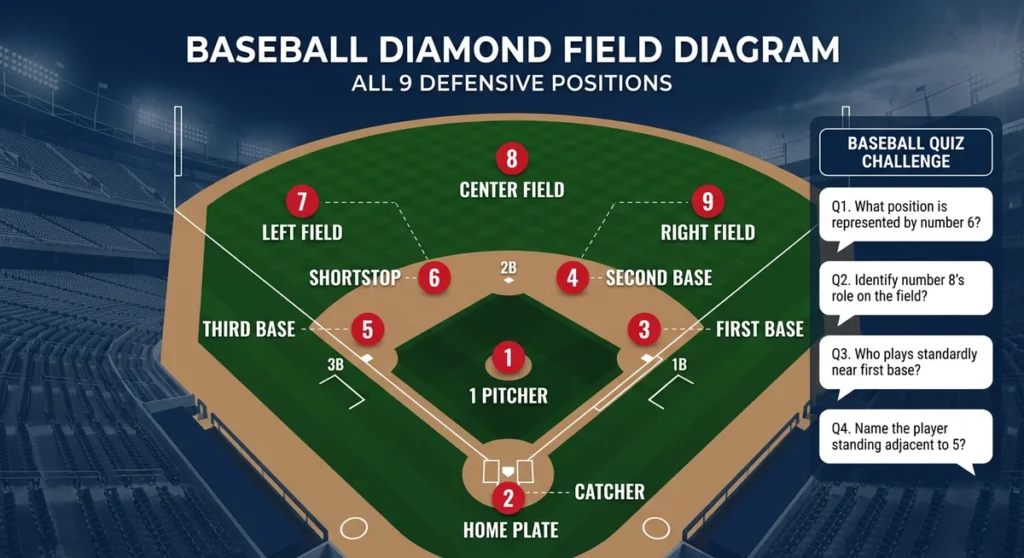
All 9 Baseball Positions Explained
Pitcher (1)
The pitcher controls the tempo of the entire game. Every play starts with them. They need a strong arm, mental toughness, and the ability to repeat their delivery consistently. League rules require a closed or basket web so batters can’t see the pitcher’s grip.
Famous: Clayton Kershaw, Max Scherzer, Sandy Koufax
Catcher (2)
The catcher is the field general. They see the entire field, call pitches, block balls in the dirt, and control the running game. It’s the most physically demanding position — squatting for 100+ pitches per game while wearing full gear.
Famous: Yadier Molina, Johnny Bench, Ivan Rodriguez
First Base (3)
First base is where throws land. The first baseman needs to scoop low throws, stretch for off-target balls, and be a reliable target on every ground ball play. Left-handed throwers have a natural advantage here — the glove is on the right hand, closer to the field.
Famous: Albert Pujols, Freddie Freeman, Lou Gehrig
Second Base (4)
Second basemen need quick hands, fast feet, and the ability to turn double plays. It’s a position built on speed and agility more than arm strength — the throw to first is short, so transfer speed matters more than arm power.
Famous: Jose Altuve, Robinson Cano, Craig Biggio
Third Base (5)
The “hot corner” — third basemen stand 90 feet from power hitters and need lightning reflexes to handle rockets down the line. They also need the strongest infield arm for the long throw across the diamond to first base.
Famous: Nolan Arenado, Brooks Robinson, Mike Schmidt
Shortstop (6)
The most demanding infield position. Shortstops need the widest range, the strongest infield arm, and the ability to make plays from any angle — deep in the hole, up the middle, or charging in on slow rollers. Often the best all-around athlete on the team.
Famous: Derek Jeter, Ozzie Smith, Francisco Lindor
Left Field (7)
Left field sees fewer fly balls than center but still requires solid fielding and the ability to play the wall. Many teams prioritize offensive production from their left fielder — it’s often where you’ll find a team’s best power hitter who isn’t a first baseman.
Famous: Barry Bonds, Ted Williams, Rickey Henderson
Center Field (8)
Center field is the outfield equivalent of shortstop — the most athletic outfielder covers the most ground. Center fielders need elite speed, great instincts, and the ability to track fly balls over their shoulder. They also direct traffic for the other outfielders.
Famous: Willie Mays, Mike Trout, Ken Griffey Jr.
Right Field (9)
Right field requires the strongest outfield arm — the throw from right field to third base is the longest throw an outfielder makes. Right fielders also tend to be among the team’s better hitters, combining power at the plate with a cannon arm in the field.
Famous: Roberto Clemente, Ichiro Suzuki, Mookie Betts
Baseball Position Numbers Chart
Every position has a number used for scorekeeping. When you see “6-4-3 double play,” that means shortstop (6) to second base (4) to first base (3).
| Number | Position | Abbreviation | Key Role |
|---|---|---|---|
| 1 | Pitcher | P | Throws to batters, controls game tempo |
| 2 | Catcher | C | Receives pitches, calls the game, blocks |
| 3 | First Base | 1B | Catches throws from infielders, scoops |
| 4 | Second Base | 2B | Turns double plays, covers right side |
| 5 | Third Base | 3B | Fields hot shots, long throw to first |
| 6 | Shortstop | SS | Most range, covers left side of infield |
| 7 | Left Field | LF | Covers left outfield, backs up third |
| 8 | Center Field | CF | Covers most ground, leads outfield |
| 9 | Right Field | RF | Strongest outfield arm, throws to third |
DH (Designated Hitter): Not a fielding position — the DH bats in place of the pitcher in leagues that use it. There is no position number for the DH.
How Coaches Actually Pick Positions
If you’ve ever wondered why the coach put you at second base instead of shortstop, here’s the real logic:
1. Arm strength is the first filter. The strongest arm on the team usually plays shortstop, third base, or pitcher. If your arm is average, you’re looking at second base, first base, or left field.
2. Speed determines outfield placement. The fastest player goes to center field. Period. Left and right field go to the next fastest with the better arms.
3. Size matters at catcher and first base. Catchers need to be durable — the position beats up small players. First basemen benefit from height and reach.
4. Hands and reflexes drive the middle infield. The quickest hands go to shortstop and second base. Transfer speed — how fast they get the ball from glove to throwing hand — is the separator.
5. Everyone starts with the bat. At youth levels, the best hitter often plays shortstop. As players specialize, defensive skills become the primary placement tool.
Frequently Asked Questions