
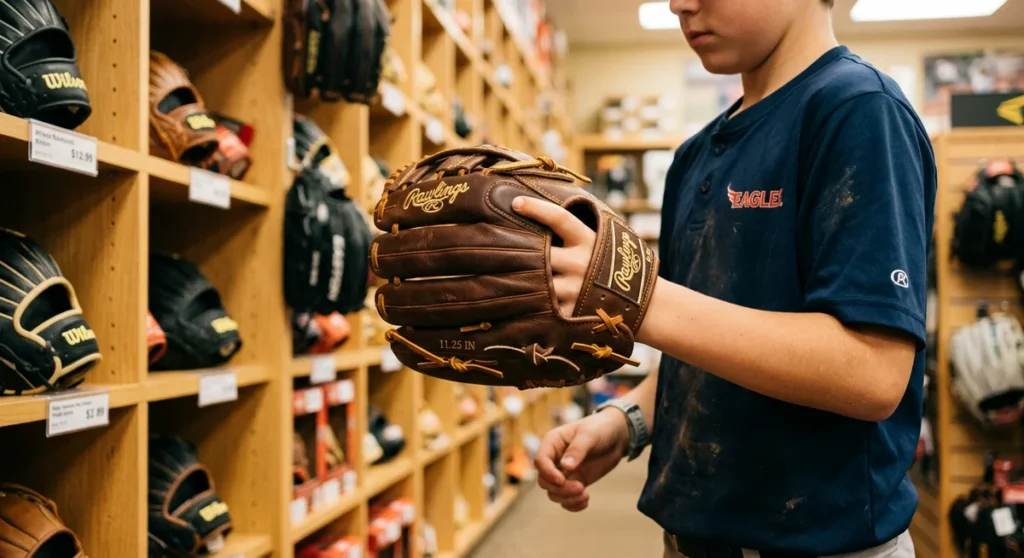
Pick your player’s age, position, and sport. We’ll recommend the right glove size, web type, and back style. Or scroll down for the full sizing charts.
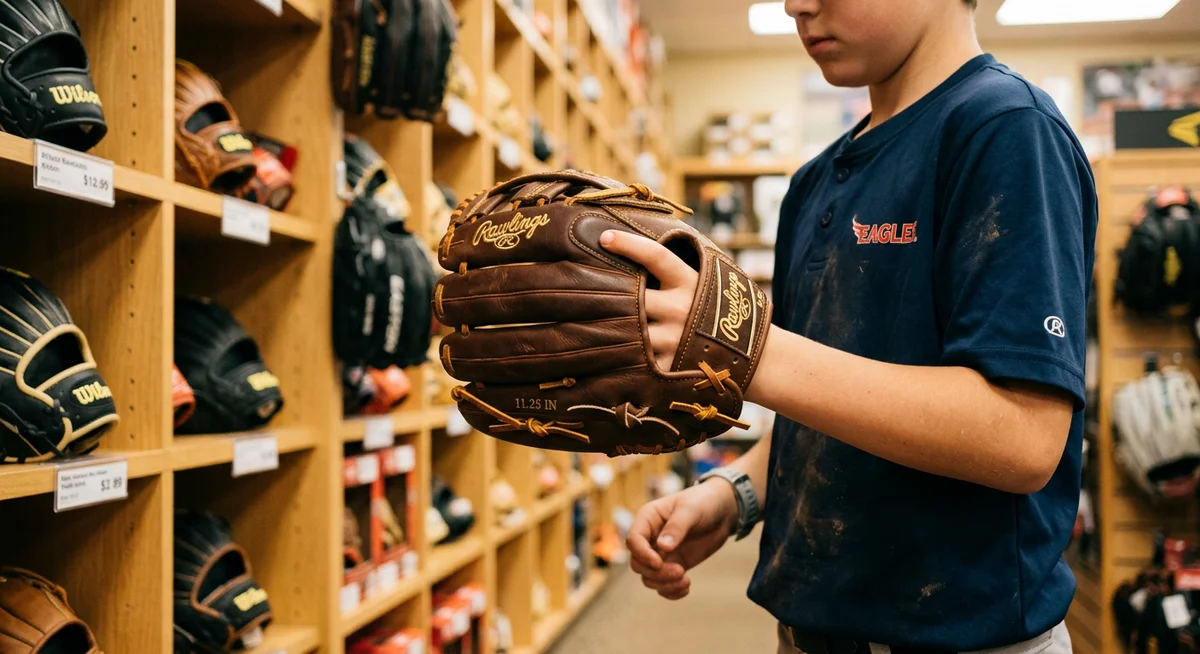
Find Your Glove Size
This calculator recommends baseball or softball glove size, web type, and back style based on player age, position, and sport. Position determines web pattern (closed for pitchers, I-Web for infielders, trapeze for outfielders). Age narrows the size range. Most generic charts skip the web type entirely — that’s the step that actually affects performance.
Answer three questions. We’ll recommend your glove size, web type, and back style.
Position determines glove type. Age determines size range.
Baseball Glove Size Chart (Full Reference)
Baseball glove sizes range from 9–10 inches for T-Ball through 12.75 inches for adult outfielders. Catchers use mitts measured by circumference (29.5″–34″) rather than length. Softball gloves run larger at every position because the ball is bigger. When between sizes, infielders should go smaller for transfer speed; outfielders should go larger for reach.
Here’s the complete sizing table by age group and position. This is the same data the calculator uses.
| Age Group | Pitcher | Catcher | First Base | Infield | Outfield | Utility |
|---|---|---|---|---|---|---|
| T-Ball (4-6) | 9-10″ | 29.5-30″ | 11-11.5″ | 9-10″ | 9.5-10.5″ | 9.5-10″ |
| Youth (7-9) | 10.5-11″ | 30-31″ | 11-11.5″ | 10-10.75″ | 10.5-11.5″ | 10.5-11″ |
| Youth (10-12) | 11-11.5″ | 31-32.5″ | 11.5-12″ | 10.75-11.5″ | 11.5-12″ | 11-11.5″ |
| Teen (13-15) | 11.5-12″ | 32-33.5″ | 12-12.5″ | 11.25-11.75″ | 12-12.75″ | 11.5-12″ |
| HS / Adult (16+) | 11.5-12″ | 32.5-34″ | 12-13″ | 11.25-11.75″ | 12.5-12.75″ | 11.75-12.25″ |
Softball Glove Size Chart
Softball gloves run larger than baseball gloves because the ball is bigger (12″ circumference vs 9″).
| Age Group | Pitcher | Catcher | First Base | Infield | Outfield | Utility |
|---|---|---|---|---|---|---|
| Youth (7-10) | 10.5-11.5″ | 30-31″ | 11.5-12″ | 10.5-11″ | 11-11.5″ | 10.5-11″ |
| Youth (11-13) | 11.5-12″ | 31-32.5″ | 12-12.5″ | 11-11.5″ | 12-12.5″ | 11.5-12″ |
| Teen (14-16) | 12-12.5″ | 32.5-33.5″ | 12.5-13″ | 11.5-12″ | 12.5-13″ | 12-12.5″ |
| Adult (17+) | 12-13″ | 33-34.5″ | 13-14″ | 11.5-12.5″ | 13-14″ | 12-12.5″ |
Between sizes? Go smaller for infielders (quick transfer matters more than reach) and larger for outfielders (every extra half inch helps on dive plays).
Web Type by Position
Web pattern is not cosmetic — it directly affects performance at each position. Pitchers must use a closed or basket web (required by most leagues to hide grip). Infielders use I-Web or H-Web for fastest dirt-clearing and ball transfer. Outfielders use Trapeze or T-Web for maximum pocket depth on fly balls. Catchers use a one-piece solid mitt, not a fielding glove.
The web pattern isn’t cosmetic — it determines how the glove performs at each position.
| Position | Recommended Web | Why |
|---|---|---|
| Pitcher | Closed / Basket | Hides grip from batters — most leagues require a solid web for pitchers |
| Catcher | One-Piece / Solid | Closed pocket designed for receiving, not fielding — absorbs impact |
| First Base | Single Post / Modified Trap | Wide, shallow pocket for scooping throws out of the dirt |
| Infield (2B/SS/3B) | I-Web or H-Web | Open design lets dirt fall through, fastest ball-to-hand transfer |
| Outfield | Trapeze / T-Web | Deep pocket with max surface area for tracking and securing fly balls |
| Utility | H-Web | Versatile design that works at multiple positions |
Why Position Changes Everything
Position determines glove size range more than hand size does. Infielders go smaller (11–11.75″ for adults) for transfer speed; outfielders go larger (12.5–12.75″) for reach. Pitchers prioritize closed web over size. Catchers use circumference-measured mitts (32.5–34″ adult), not standard field gloves. A 12-year-old shortstop should use an 11.5″ glove — not the 12″ the age chart suggests.
Two players with the same hand size playing different positions need completely different gloves.
Infielders
Go smaller within your age range. A compact glove (11-11.75″ for adults) lets you get the ball out faster. The difference between an 11.5″ and a 12.5″ glove is measurable in transfer time — and that’s the difference between a bang-bang play at first and a runner beating the throw.
Best web: I-Web for shortstops and second basemen (quickest transfer), H-Web for third basemen (slightly deeper pocket for hard-hit balls). Avoid closed webs — they trap dirt and slow you down.
Outfielders
Go larger within your age range. An extra half inch of glove (12.5-12.75″ for adults) extends your reach on dive plays and gives you a deeper pocket to secure fly balls. Unlike infielders, transfer speed isn’t the priority — catching the ball is.
Best web: Trapeze or T-Web gives maximum surface area and a deep channel for the ball to settle into. Closed back adds wrist support for fully extended catches.
Pitchers
Size matters less than web type. Pitchers need a closed or basket web — league rules in most organizations require it so batters can’t see the pitcher’s grip. Size is typically 11.5-12″ for adults — big enough to field comebackers, small enough to control.
Best web: Closed web, period. If a batter can see your fingers through the web, they know what’s coming.
Catchers
Catcher’s mitts are measured differently. They’re measured around the circumference, not top to bottom like field gloves. Adult mitts run 32.5-34″, youth 30-32.5″. Mitts don’t have individual fingers — they use a one-piece closed pocket designed to absorb impact.
Fit tip: A catcher’s mitt should feel snug when new. It’ll break in and form to your hand over 50-100 catches.
Frequently Asked Questions
Most 7-year-olds need a 10–11″ glove depending on position. Infielders lean 10–10.75″, outfielders 10.5–11.5″. The glove should close easily in one hand — if it can’t, it’s too big.
Most 7-year-olds need a 10-11″ glove depending on position. Infielders should lean toward 10-10.75″, outfielders toward 10.5-11.5″. At this age, the glove should close easily in one hand — if your player can’t squeeze it shut, it’s too big or too stiff. Look for youth models with adjustable wrist closures.A typical 10-year-old uses 10.75–12″ depending on position. Infielders: 10.75–11.5″. Outfielders: 11.5–12″. Pitchers: 11–11.5″ with a closed web. Catchers: dedicated mitt (31–32.5″).
A typical 10-year-old uses a 10.75-12″ glove. Position matters more at this age since players are settling into roles. Infielders: 10.75-11.5″. Outfielders: 11.5-12″. Pitchers: 11-11.5″ with a closed web. Catchers get a dedicated mitt (31-32.5″).At 12, most players use adult-adjacent sizing — infielders 11–11.5″, outfielders 11.5–12″. This is also the age to transition from youth to intermediate/adult gloves if the hand has outgrown youth finger stalls.
At 12, most players use adult-adjacent sizing. Infielders: 11-11.5″. Outfielders: 11.5-12″. Pitchers: 11-11.5″. This is also the age when players should transition from youth to intermediate or adult gloves if their hand is big enough — youth models at this size feel flimsy.Most MLB infielders use 11.25–11.75″. Shortstops and second basemen go 11.25–11.5″ for transfer speed; third basemen go 11.5–11.75″ for pocket depth. Nearly all use I-Web or H-Web with open backs.
Most MLB infielders use 11.25-11.75″ gloves. Shortstops and second basemen typically go 11.25-11.5″ for maximum transfer speed. Third basemen go 11.5-11.75″ for the extra pocket depth on hard-hit balls. Almost all use I-Web or H-Web patterns with open backs.Softball gloves are larger at every position because the ball is bigger (12″ vs 9″ circumference). Softball outfield gloves run 13–14″ vs 12.5–12.75″ for baseball. The pocket is wider and shallower — a baseball glove won’t seat a softball properly.
Softball gloves are larger at every position because the ball is bigger (12″ circumference vs 9″). Softball outfield gloves run 13-14″ vs 12.5-12.75″ for baseball. The pocket is also wider and shallower to accommodate the larger ball. Using a baseball glove for softball is playable but not ideal — the ball won’t seat properly in the pocket.No. An oversized glove teaches bad habits — trapping instead of catching, which kills transfer speed. Buy for now, not next year. A $40 glove that fits beats a $150 glove that doesn’t.
No. An oversized glove teaches bad habits — the player compensates by trapping instead of catching, which kills transfer speed. Buy for now, not for next year. A $40 glove that fits is better than a $150 glove that’s too big. Youth gloves with adjustable wrist closures help bridge small size gaps.Measure from fingertip to base of palm — but hand size matters less than position and age. A 7″ and 7.5″ hand use the same infield glove. Position determines the glove size, not the hand.
Measure from the tip of your index finger to the base of your palm (where your wrist starts). That’s your hand length. But honestly, hand measurement matters less than position and age — a 7″ hand and a 7.5″ hand both use the same size infield glove. Position determines the glove, not your hand.Around age 12–13, or when fingertips push past the end of the finger stalls. Most players jump between 11.5″ youth and 11.5″ adult — same number, but the adult has deeper stalls and a stiffer pocket.
Typically around age 12-13, or when their hand fills out a youth glove completely. The test: if the glove’s finger stalls are shorter than their fingers (fingertips pushing past the end), it’s time to move up. Most players make the jump between 11.5″ youth and 11.5″ adult — same size number, but the adult glove has deeper finger stalls and a stiffer pocket.