
Most players pick the wrong construction for the wrong reason. They see “balanced” on the label of a one-piece bat, assume light equals comfortable, and walk into the season with a bat that punishes every mishit. The construction question isn’t about weight — it’s about what happens to your hands when you hit the ball an inch off-center.
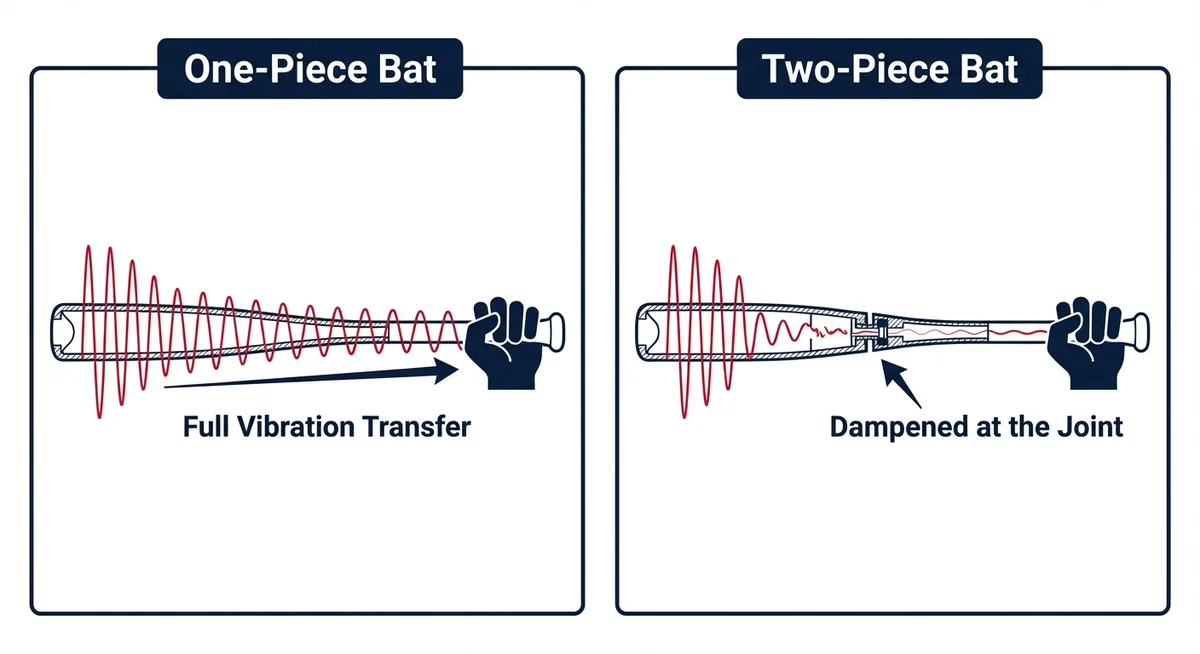
A one-piece bat is manufactured as a single unit — handle and barrel bonded together with no flex point. A two-piece bat joins a separate handle and barrel at a connection point that absorbs vibration on off-center contact. For contact hitters, this distinction matters more than swing weight.
The Misconception Everyone Gets Wrong
Here’s the mistake: a player (or a parent) wants a bat that’s easy to swing and comfortable to hit with, so they look for something balanced and light. A sales rep points them to a one-piece alloy — it’s balanced, it’s a -10, it swings easily. That all sounds right.
It isn’t.
Light and comfortable are not the same thing. A one-piece bat can be balanced, light, and still sting badly on every mishit. The weight affects how fast you swing. The construction affects what happens when you don’t hit the sweet spot — which, for most players most of the time, is every other at-bat.
Contact hitters make contact constantly. That means off-center hits are part of the job. Get the construction wrong and your hands remind you every time.
What Is a One-Piece Bat?
A one-piece bat is built exactly like it sounds: handle and barrel are one continuous piece of material, either alloy (aluminum) or composite. There’s no joint, no flex point, no interruption between where you hold it and where you hit the ball.
That direct connection is a feature for certain players. On solid contact, one-piece bats transfer energy efficiently. There’s no energy loss at a flex joint — the barrel drives through the ball with full mass behind it. Power hitters who generate high swing speed and hit through the zone love this.
The tradeoff: vibration travels the same path as energy. A mishit sends the shock wave straight up the barrel and into your hands. The harder and stiffer the material, the more clearly you feel it.
One-piece alloy is the original baseball bat construction. One-piece composite exists too, and while composite dampens vibration somewhat compared to alloy, it still transmits more than a two-piece design.
What Is a Two-Piece Bat?
A two-piece bat connects a separate handle and barrel through a joint — typically a ring, sleeve, or composite connection system depending on the manufacturer. That connection point does two jobs: it allows a small amount of flex during the swing, and it interrupts the vibration path on mishits.
The flex gives a two-piece bat its distinctive feel — sometimes called “whip” — that many hitters describe as the barrel loading slightly and snapping through the zone. It’s subtle, but players who’ve swung both constructions feel it immediately.
The bigger deal for contact hitters is the vibration interruption. When the ball hits the outer edge of the barrel or the inner quarter, the shock wave hits that connection joint before reaching your hands. Most of that energy gets absorbed or dispersed rather than transmitted. Your hands feel it, but not at full force.
Two-piece bats are available in alloy handle / composite barrel (hybrid), composite handle / composite barrel (full composite), and composite handle / alloy barrel configurations. The exact material at the joint matters for feel, but all two-piece designs offer more vibration dampening than one-piece.
The Science: Why Off-Center Contact Hurts More in a One-Piece
This isn’t a feel thing — it’s physics. Research from Penn State’s acoustics lab identifies the specific vibration frequencies that cause pain: the range between 600 and 700 Hz is where hand sting is most acutely felt. The second bending mode of the bat — the vibration pattern that peaks at the handle — is the primary driver of the pain felt in the web between the thumb and forefinger of the top hand.
One-piece bats, with no interruption in the material path, transmit those frequencies directly. Two-piece designs with connection systems break the transmission path before it reaches the handle. A 2012 vibration damping study confirmed that two-piece construction with targeted damping mechanisms is the most effective design approach for reducing painful sting — more effective than knob inserts or grip tape alone.
Tape addresses skin friction, not structural vibration. If the shock wave is traveling up a one-piece alloy handle at 650 Hz, no amount of cushion grip is absorbing that. You need a material interruption at the construction level — which only a two-piece design provides.
One-Piece vs Two-Piece by Player Type
| One-Piece | Two-Piece | |
|---|---|---|
| Construction | Handle + barrel = single unit | Separate handle and barrel joined at a connection point |
| Vibration on mishits | Travels directly to hands | Absorbed/dispersed at the connection joint |
| Barrel feel | Stiff, direct | Some flex — barrel “loads” slightly |
| Energy transfer on solid contact | Maximum — no flex loss | Slightly reduced — joint absorbs some energy |
| Best for | Power hitters — high swing speed, strong hands | Contact hitters — frequent contact, want feel and comfort |
| Common materials | Alloy or one-piece composite | Hybrid (alloy barrel / composite handle) or full composite |
Contact hitters: two-piece composite. Power hitters: one-piece (alloy or composite) or hybrid. Versatile players transitioning: one-piece helps build the mechanics and strength that power hitting requires.
The Weight Confusion — Cleared Up
Here’s where it goes wrong for a lot of buyers: they conflate drop weight with construction. These are independent variables.
Drop weight tells you how light or heavy a bat swings relative to its length. A -10 bat is lighter than a -8 bat of the same length, regardless of construction. Construction tells you how the bat is built — one piece or two.
A -10 one-piece alloy is light and will still sting on mishits. A -10 two-piece composite is the same swing weight — and handles off-center contact much more comfortably. The drop weight is the same. The construction experience is not.
This is the exact mistake youth coaches, rec league parents, and well-meaning salespeople make. They hand a 10-year-old contact hitter a light one-piece alloy and say “it’s balanced, it’ll be easy to swing.” It is easy to swing. It’s not easy to hit with 40 times a week.
The bat materials guide → covers construction differences across alloy, composite, and hybrid in full — including how barrel material and handle material interact independently of whether the bat is one-piece or two.
Which Construction Is Right for You?
For specific bat recommendations by player type, see Best BBCOR Bats for Contact Hitters → — every bat on that list is two-piece composite, chosen specifically for the player type this guide describes.
Frequently Asked Questions
Is a one-piece or two-piece bat better?
It depends on your player type. Two-piece bats are better for contact hitters because the connection joint absorbs vibration on off-center contact. One-piece bats are better for power hitters because they transfer energy more directly and efficiently on solid contact. Neither is universally better — construction should match how you hit.
Do two-piece bats reduce hand sting?
Yes. The connection joint between the handle and barrel in a two-piece bat interrupts the vibration path before it fully reaches your hands. Research on bat vibration identifies the 600–700 Hz range as the primary cause of sting — two-piece construction dampens this at the structural level, which grip tape and knob inserts cannot replicate.
Can a light one-piece bat work for contact hitters?
Drop weight and construction are independent variables. A light one-piece bat has the swing weight of a light bat, but still transmits more vibration on mishits than a two-piece bat of the same weight. Contact hitters who want both light swing weight and reduced sting should be in a two-piece composite — not a lighter one-piece.
What is the best construction for a youth contact hitter?
Two-piece composite in the drop weight appropriate for their age — typically -10 for most 9–12 year olds. The two-piece design reduces hand sting on mishits, which is especially important for younger players making frequent contact and developing their swing mechanics.