
Every baseball bat traces its shape back to the same question players have been asking for over 150 years: how do you hit the ball harder without the stick breaking in your hands? The answer has changed every generation. In the 1870s it was a turned hickory cudgel as long as a fencepost. By 1920 it was a thinner, whippier ash bat built for Babe Ruth’s uppercut. By the 1970s aluminum had arrived in college dugouts. Today an eleven-year-old steps into the box holding a composite barrel that costs more than his mitt and has to pass a bat-certification stamp before he’s allowed to swing it. This is the story of how the bat got here.
The hickory era: 1870s bat-makers and the turned-wood standard
Before there was a Louisville Slugger, there were hundreds of local woodturners. Bats in the 1870s were whatever a player could get a carpenter to shape from a piece of seasoned hardwood — usually hickory, because hickory was everywhere east of the Mississippi and it could take a pounding. These bats were heavy. A 38-ounce bat was ordinary. Some early-career Cap Anson bats reportedly weighed north of 42 ounces. Players choked up and slashed with them rather than swinging from the heels.
The bats were also long. The rule book set a 42-inch maximum in 1869 and left thickness effectively unregulated. A typical 1875 bat measured about 36 inches long and over 2.75 inches at the barrel. Players ordered bats from local turners by the feel of the handle. There was no model number. There was no database. If you wanted the same stick you hit with last week, you hoped the shop was still standing.
Louisville Slugger and the ash takeover (1884–1920)
The commercial bat industry began in 1884 when 17-year-old Bud Hillerich turned a custom bat for Pete Browning of the Louisville Eclipse. Browning got three hits with it the next day and the story spread. By 1894 Hillerich’s shop was producing bats under the Louisville Slugger name, and by 1905 Honus Wagner had signed the first player endorsement in sports history — his signature engraved into the barrel, his model available to anyone with a dollar.
Ash became the wood of choice in this period, replacing hickory for most professional use. Ash is lighter. Ash flexes at contact. An ash bat could be made thinner in the handle without snapping, which meant a player could generate more bat speed without losing the sweet spot. The shift from hickory to ash was the single biggest change in bat performance in the first fifty years of the game, and it happened before most fans realized it was happening.
The deadball swing: long bats, choked hands, slap contact
Between 1900 and 1919 the ball itself was dead — softer yarn, inconsistent cover, same ball used for an entire game until it was lost or shredded. A hitter like Ty Cobb approached this ball the way you’d approach a problem you had to solve with patience. Cobb choked up three or four inches on a 40-ounce bat and slashed line drives. Ruth, before he was traded from the Red Sox, was doing the same thing — choking up on a long, heavy bat he’d use to spray contact hits back through the box.
The deadball bat was a punishment tool, not a launch tool. It was designed for hand-eye contact against pitchers who were throwing the same scuffed, tobacco-stained ball the whole afternoon. Nobody was swinging for the fences because the fences were 420 feet away and the ball didn’t carry. The scandal-era champions — the 1917 Red Sox, the 1919 White Sox, the teams we now associate with the gambling culture of that generation — all hit with bats that looked like fenceposts to a modern eye.
The liveball shift: Ruth, the uppercut, and the thinner handle
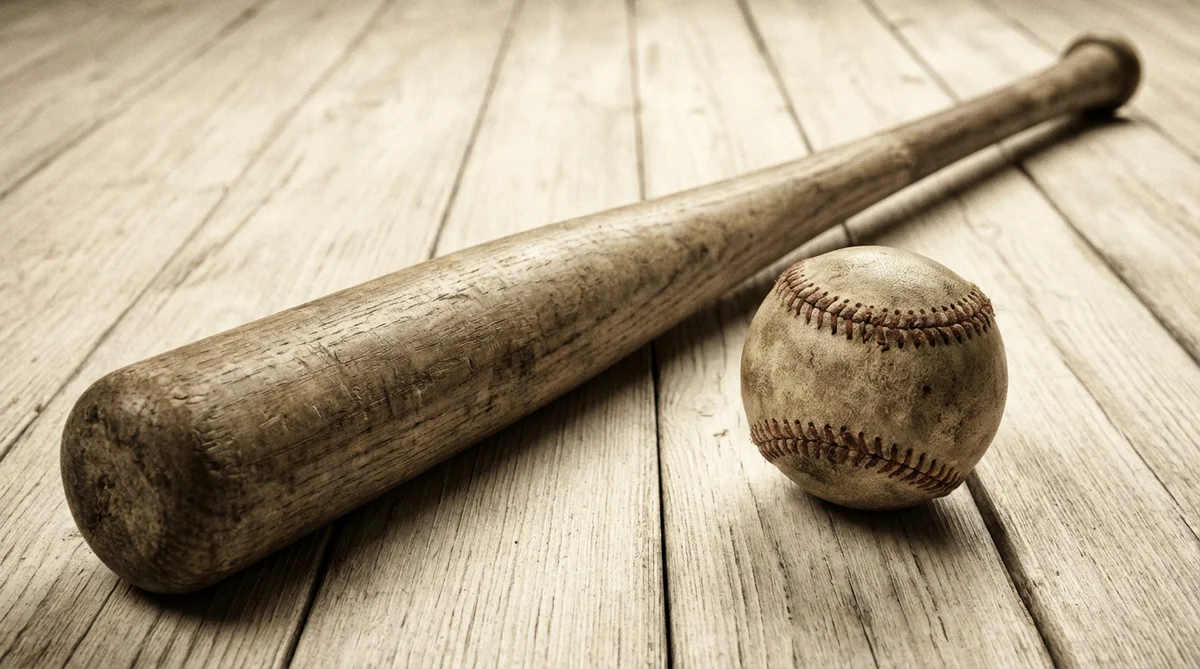
Ruth’s conversion from pitcher to everyday outfielder in 1918 was also, quietly, a revolution in bat design. Ruth swung a 42-ounce bat early in his Yankees career but gradually shortened and lightened it through the 1920s. He also pulled his bottom hand down to the knob instead of choking up. This required a bat with a thinner handle and a bigger concentrated barrel — and Hillerich’s shop was happy to turn one for him.
By 1930 every power hitter in both leagues was swinging a Ruth-style bat: thin handle, big barrel, 34–36 ounces, ash. The uppercut was a real thing now. The home run was a real thing now. The bat had changed its job from contact tool to launch tool, and the design followed in about a decade.
Postwar standardization (1945–1970)
The generation after World War II was the quietest in bat-design history. Hillerich & Bradsby’s Louisville Slugger had something close to a monopoly. Adirondack Big Stick and a handful of regional makers held the rest. Rule changes were minimal. Ted Williams swung a 32-ounce bat. Mickey Mantle swung a 34-ounce bat. Willie Mays swung one somewhere in between. All three were ash. All three came from the same few factories.
This stability lasted until the late 1960s, when two things happened at once: the NCAA realized it was running out of good-quality ash, and a little aluminum-casting firm from California realized a metal bat could be made to ring.
Aluminum arrives (1970s) and the youth/amateur split
Worth produced the first commercial aluminum bat in 1970. Easton bought the aluminum-bat patent shortly after and perfected single-wall construction through the decade. By 1975 aluminum was legal in college baseball. By the early 1980s it had taken over Little League, high school, and NCAA play entirely.
The appeal was obvious: an aluminum bat didn’t break. A bat that cost $40 could last a whole season instead of a whole week. But aluminum also hit the ball harder. A 1985 single-wall aluminum bat had an exit-velocity performance that pro scouts compared to a juiced ball. By the end of the 1990s multi-wall aluminum and composite-barrel prototypes were producing ball-exit speeds that caused serious pitcher-safety debates.
This is where the bat split into two separate product universes. Pro baseball stayed on wood by rule. Amateur baseball went to aluminum, then composite, then hybrid. The question modern players ask — which BBCOR bat should I swing? which USSSA? which USA? — is a question that didn’t exist in 1975 because the regulatory categories hadn’t been invented yet.
BBCOR arrives (2011) and the death of the trampoline era
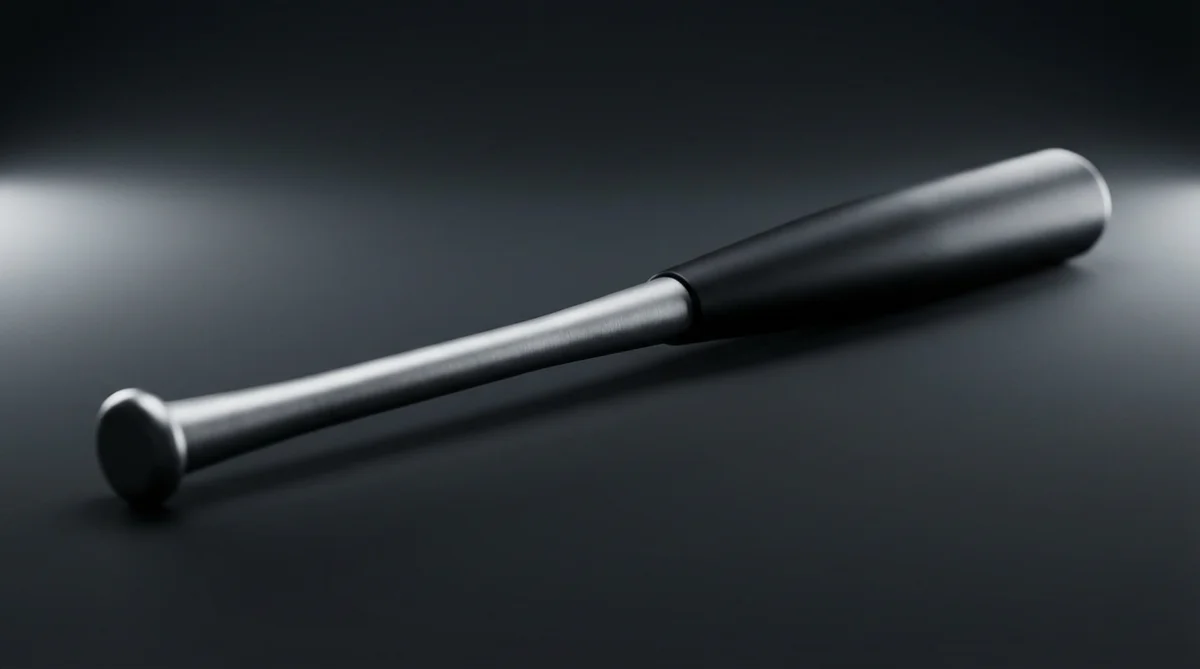
In 2011 the NCAA, followed quickly by the NFHS, replaced the old BESR bat-performance standard with BBCOR — Bat-Ball Coefficient of Restitution. The new standard capped ball-exit performance at a level close to a top-grade wood bat. In effect it killed the aluminum advantage at the high-school and college level.
BBCOR sparked a design arms race inside a tighter box. If you can’t beat the ceiling, you design toward it — from every direction. Composite barrels with optimized wall thickness. Two-piece connections that isolate handle sting. End-loaded versus balanced swing weights. Hybrid designs that pair a composite barrel with an alloy handle. The modern BBCOR bat is an engineering object built to legally maximize a single physics constant. See the full BBCOR category or this year’s BBCOR roundup for where the field stands today.
USSSA and USA: the youth regulatory split
Below the high-school level, the regulatory picture is messier. USSSA (travel ball, showcase tournaments) allows bats with a higher performance ceiling — a 1.15 BPF stamp. USA Baseball (Little League, Cal Ripken, most rec leagues) adopted a stricter wood-like standard in 2018. A USSSA bat is not legal in a USA league and vice versa, even when they’re the same barrel diameter.
This matters because an 11-year-old making the jump from rec ball to a travel roster is not just changing teams — he’s changing bats. Families who bought a top USSSA bat for travel ball often keep a separate USA bat for league play. The two stamps drive two separate product lines from every manufacturer.
Maple, birch, and the pro-level wood debate
Pro baseball never left wood. But the wood changed. Barry Bonds famously switched to maple during his 2001 home-run season, and within five years maple had overtaken ash as the dominant pro bat wood. Maple is harder, denser, and has a thinner grain pattern that resists flaking. Ash tends to flake along its grain as it wears; maple cracks cleanly or not at all.
Birch emerged in the early 2010s as a middle option — more flex than maple, more durability than ash. A player who had grown up on ash and couldn’t adjust to the stiffness of maple could land on birch and keep most of his feel. As of the mid-2020s most pros swing maple, a significant minority swing birch, and a handful of veterans still swing ash out of preference. For amateur and adult wood leagues, the options are the same — see our full wood-bat guide for how the three woods perform for non-pro hitters.
Composite vs. alloy: what amateur players actually buy today
The modern bat-buying decision for an amateur player is mostly a choice between three construction types: one-piece alloy, one-piece composite, and two-piece hybrid or composite. Each has a clear use case.
One-piece alloy is for the versatile hitter who wants zero break-in and a stiff, responsive feel. One-piece composite is for the contact hitter who wants a bigger sweet spot and can tolerate a break-in period. Two-piece composite is for the contact-to-power transition hitter who wants vibration isolation and a more forgiving mis-hit. End-loaded two-piece designs are for pure power hitters who want to feel the barrel at the end of the swing.
The bat has been evolving toward this level of specificity for 150 years. The hickory cudgel of 1875 was a one-size tool. The 2026 BBCOR lineup is a catalog of engineered answers to individual swing profiles. The history in between is what took us from one to the other.
Where to go from here
If you’re trying to pick your next bat, start with the certification your league requires, then match the construction to your swing profile:
- High school or college — BBCOR bats | best BBCOR roundup
- Travel ball (USSSA) — USSSA bats | best USSSA roundup
- Little League / rec ball (USA) — best USA bats
- Adult wood leagues — best wood bats