
The most common mistake hitters make when stepping up: they hear “end-loaded” and assume that means more power. It can — but only if your mechanics can sustain bat speed under the extra weight. If they can’t, you’ve just paid $350 to hit slower. This guide settles the end-loaded vs balanced question with the one answer that actually matters: it depends entirely on how you swing.
The short answer: End-loaded bats put extra mass near the barrel to increase swing momentum — right for power hitters whose mechanics support it. Balanced bats distribute weight evenly for a lighter, faster swing feel — right for contact hitters, most youth players, and anyone building mechanics. Choosing end-loaded before your swing can support it typically makes things worse, not better.
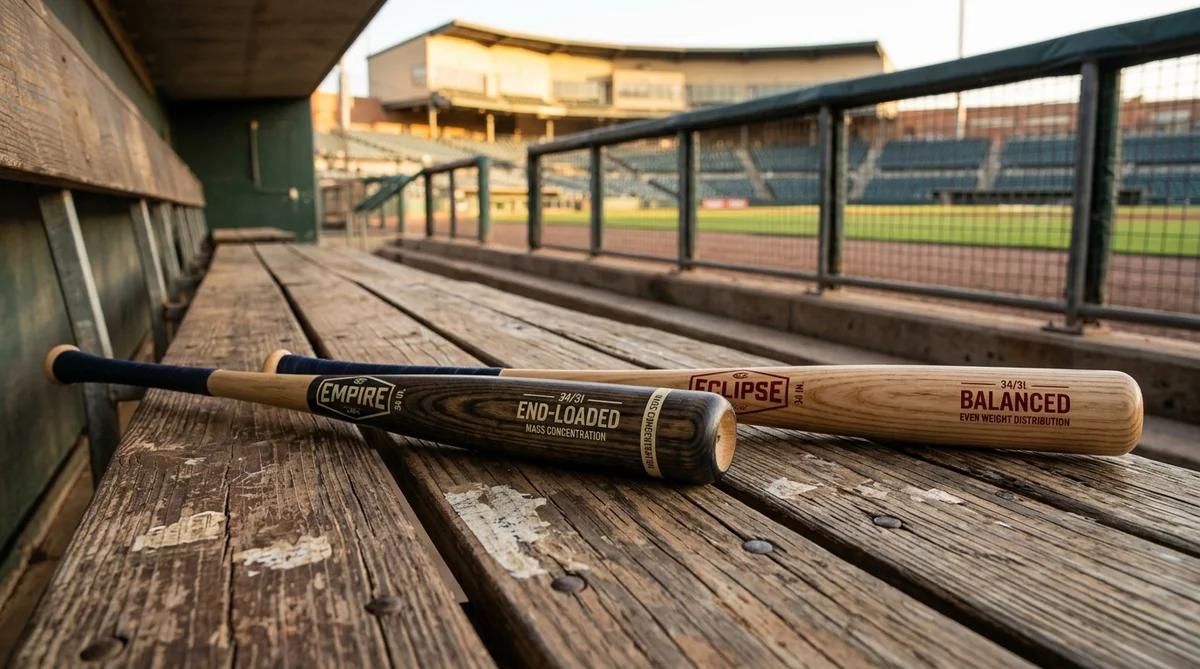
What Is an End-Loaded Bat?
An end-loaded bat concentrates mass toward the barrel end, increasing MOI (moment of inertia) and producing a heavier swing feel. This added barrel momentum can increase exit velocity — but only if the hitter’s mechanics can sustain bat speed under the extra load.
The physics: when mass sits toward the barrel, the bat’s effective swing weight increases beyond what the labeled drop weight suggests. A -3 end-loaded BBCOR bat doesn’t swing like a standard -3. It swings heavier. That extra barrel momentum is the source of both its advantage (more mass through the zone at impact) and its risk (slower bat speed if you’re not strong enough to move it efficiently).
End-loaded bats are built for power hitters who already generate above-average bat speed. They’re not a shortcut to power — they’re a tool that amplifies existing power. Common examples: DeMarini The Goods (end-load via steel knob weight), Marucci CatX RCKLESS (alloy end-load via barrel wall design). Both assume the swing is already there.
“An end-loaded bat concentrates mass toward the barrel end, increasing MOI and producing a heavier swing feel. This added barrel momentum can increase exit velocity — but only if the hitter’s mechanics can sustain bat speed under the extra load.”
What Is a Balanced Bat?
A balanced bat distributes weight evenly throughout the barrel and handle, producing lower MOI and a lighter swing feel. Even weight distribution helps hitters reach all parts of the plate and maximize bat speed — correct for contact hitters and most youth players.
The physics: balanced bats have a lower effective swing weight relative to their labeled drop. A balanced -3 BBCOR swings lighter than an end-loaded -3 — even at the same actual weight. That lighter feel translates directly into bat speed for most hitters. More bat speed means more time to read the pitch, better coverage on the outer third, and more consistent contact on off-speed.
Balanced bats are not the “safe” option for players who can’t handle end-loaded. They’re the correct option for the majority of hitters. Contact hitters, versatile players, and developing hitters should be in balanced bats — not because they’re weaker, but because bat speed and barrel control are more important to their game than raw barrel momentum. Common examples: Louisville Slugger Meta (three-piece composite, neutral balance), DeMarini CF fastpitch (balanced two-piece), Rawlings ICON (balanced two-piece composite).
“A balanced bat distributes weight evenly throughout the barrel and handle, producing lower MOI and a lighter swing feel. Even weight distribution helps hitters reach all parts of the plate and maximize bat speed — correct for contact hitters and most youth players.”
How Swing Weight Actually Affects Performance
Bat speed and mass at contact both contribute to exit velocity. End-loaded bats bet on mass. Balanced bats bet on speed. Which bet wins depends on the hitter’s mechanics.
Here’s the part most explainers skip: the relationship isn’t linear. If an end-loaded bat costs you 3 mph of bat speed, you’ve almost certainly lost ground on exit velocity — because bat speed matters more than bat mass in the exit velocity equation for most amateur hitters. Research consistently shows that for most players, a 1 mph drop in bat speed requires roughly 6–8% more bat mass to offset at contact. Almost nobody achieves that offset ratio outside of elite strength levels.
Barrel control matters too. End-loaded bats are less forgiving on mishits because more mass toward the barrel shifts the sweet spot toward the end. Balanced bats have a more centered sweet spot, which is why contact hitters consistently prefer them even when they have the bat speed to swing heavier.

Construction type and certification are separate questions from swing weight. Both end-loaded and balanced bats exist in composite, alloy, and hybrid constructions across every certification (BBCOR, USSSA, USA). Read the bat materials guide → and the composite vs alloy explainer → if you’re still deciding on construction. Settle swing weight first, then construction.
End-Loaded vs Balanced — Head-to-Head
| Factor | End-Loaded | Balanced |
|---|---|---|
| Swing feel | Heavier at the barrel | Even, lighter feel |
| MOI | Higher | Lower |
| Bat speed impact | Slower for most hitters | Faster for most hitters |
| Best for | Power hitters with strong mechanics | Contact, versatile, youth, developing hitters |
| Plate coverage | Narrower — harder to cover outer third | Full plate coverage |
| Off-speed handling | Harder to adjust | Easier to adjust |
| Mishit forgiveness | Lower — sweet spot biased toward barrel end | Higher — more centered sweet spot |
| Durability | No difference | No difference |
| Price premium | None — both price tiers carry both options | None |
Which Swing Weight Is Right for Your Player Type?
Contact Hitters: Balanced, Almost Always
Contact hitters win by making hard contact consistently. Bat speed lets them cover more of the plate, handle off-speed, and stay on breaking balls that move late. End-load works against every one of those strengths.
The only exception: a contact hitter who has genuinely maxed out bat speed and is hitting balls consistently to the pull side. That profile is rarer than most hitters think at the youth and high school levels. If you’re a contact hitter who’s already late on fastballs, the answer is not end-loaded — it’s better mechanics or a lighter drop weight.
Best BBCOR bats for contact hitters →Power Hitters: End-Loaded — If the Swing Supports It
End-loaded bats earn their place in a specific hitter profile: above-average bat speed, consistent barrel contact, pull-heavy approach, and the strength to get through the zone without the barrel dragging. If that’s you, end-loaded adds momentum that translates into exit velocity gains on well-hit balls.
The test: swing an end-loaded bat in live cage work for 20 pitches. If your contact rate holds and you’re not consistently late, the swing supports it. If you’re pulling off or mishitting on the barrel end, go back to balanced. This isn’t a pride call — it’s an exit velocity call.
BBCOR bat guide — power hitter options →Versatile and Developing Hitters: Balanced First
If you’re still building your swing — developing bat speed, moving up a certification, or working on mechanics — start balanced. Every time. A balanced bat won’t cap your ceiling. It will let you figure out what your ceiling actually is before committing to a heavier barrel feel. The most common version of this mistake: a 14U or 15U player moves from youth baseball to BBCOR and immediately picks end-loaded because it sounds more serious. Then spends a season fighting a bat that’s working against development. The one-piece vs two-piece guide → covers construction decisions for developing hitters.
The Most Common Mistake
Picking end-loaded because you’re a power hitter — without checking whether your mechanics actually support it.
Being a power hitter means you hit for power. It doesn’t automatically mean your swing can sustain the extra barrel weight of an end-loaded bat at full bat speed. Many hitters who describe themselves as power hitters would generate more exit velocity with a balanced bat, because their swing speed drops enough under end-load to cancel out the mass advantage.
The second most common mistake: thinking balanced means weak. Some of the highest exit velocity numbers in any certification come from balanced composites in the hands of contact hitters with elite bat speed. Bat speed is the multiplier. End-load is just one way to add mass — and it’s the wrong way for the majority of hitters.
If you’ve never had a hitting coach specifically recommend end-loaded based on your swing data, start balanced. End-load is a recommendation you earn with your mechanics — not a preference you pick based on self-assessment.