
Wrong bat length kills bat speed. Wrong drop weight gets your player flagged at the plate. Fastpitch bat sizing isn’t complicated — but most charts give you age ranges and call it a day. This guide gives you height-based length recommendations, drop weight by playing level, and the two rules that settle every “which size do I pick?” debate. We cover the full picture: length, drop weight, measuring technique, league rules, and how player type changes the math.
What size fastpitch bat do I need? Most players sized 4’4″–5’0″ need a 28–31″ bat. Length is driven by height; drop weight is driven by playing level. Start with the length chart, then match your level on the drop weight table. When in doubt on either: go shorter, go lighter.
Fastpitch Bat Length Chart
The table below is your first stop. Use height as the primary variable — age is a rough guide, but two players the same age can differ by four inches in height and legitimately need different bats.
| Player Height | Typical Age | Recommended Length |
|---|---|---|
| Under 4’0″ | 7–8 | 25–27″ |
| 4’0″–4’4″ | 8–10 | 27–28″ |
| 4’4″–4’8″ | 10–12 | 28–29″ |
| 4’8″–5’0″ | 12–14 | 29–31″ |
| 5’0″–5’4″ | 14–16 | 30–32″ |
| 5’4″–5’8″ | 16–18 | 31–33″ |
| 5’8″+ | 18+ / HS–College | 32–34″ |
When in doubt, go shorter. A bat that’s too long forces the hitter to reach, opening the swing and creating barrel drag through the zone. Too short is correctable; too long costs contact. If two lengths fit your range, start with the shorter one. Move up only when the current length feels genuinely cramped.

Drop Weight Chart by Playing Level
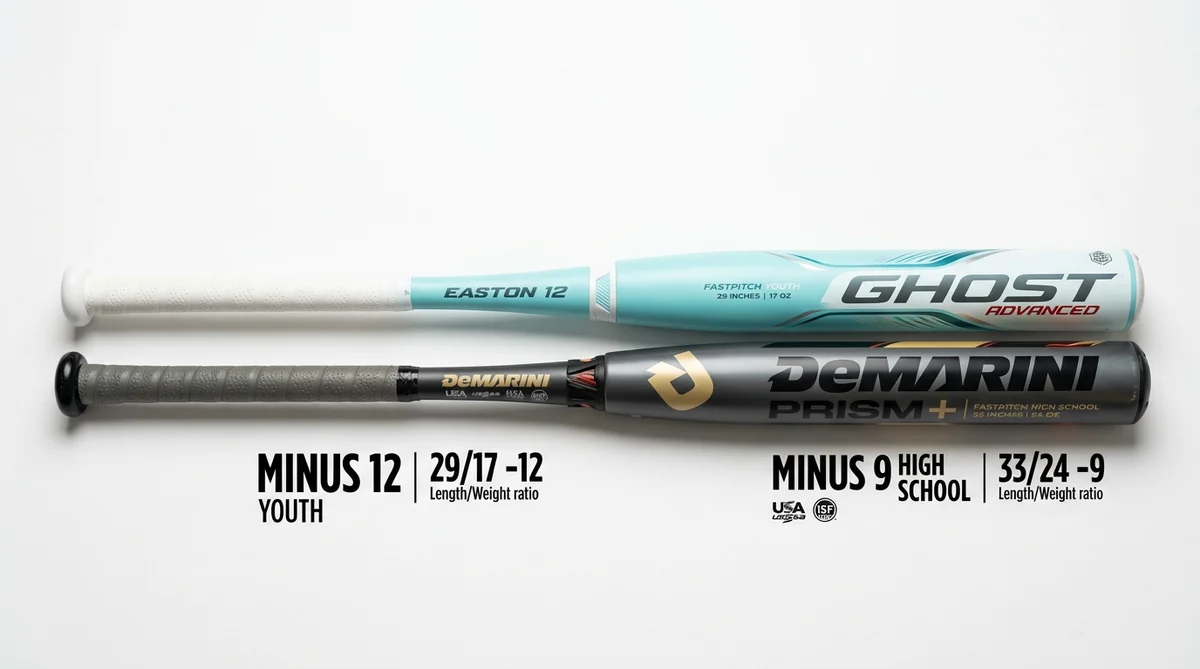
Drop weight is bat length minus bat weight in ounces. A 30″ bat weighing 20 oz = -10 drop. The bigger the number (more negative), the lighter the bat swings. For the full breakdown of how drop weight works, see our drop weight guide →.
| Level | Age Range | Standard Drop | Notes |
|---|---|---|---|
| Recreational youth | 7–10 | -12 to -13 | Max bat speed priority — lightest options |
| Travel 10U | 9–11 | -11 to -12 | Lighter end unless player is big for age |
| Travel 12U | 11–13 | -10 to -11 | Transition zone; -10 starts here |
| High school / Travel 14U+ | 14–18 | -10 | Standard at this level; -11 still legal |
| Advanced HS / Elite 16U+ | 16–18 | -8 to -9 | Top 10% only — strength must support it |
| NCAA | 18+ | -8 to -10 | NCAA approved list required — verify model |
When in doubt, go lighter. Bat speed drives exit velocity more than bat weight at most youth and high school levels. A player swinging a -10 with clean mechanics does more damage than one muscling through a -9. Move to a heavier drop only when the current weight feels genuinely easy and the results in the box are already there.
How to Measure for a Fastpitch Bat
Two quick field tests — no measuring tape needed:
The Knob-to-Chest Method
Stand the bat at your side with the knob at the center of your chest. Extend your arm parallel to the bat toward the barrel. If your fingertips comfortably reach the barrel end — that length fits. If you’re straining to touch the cap, go shorter. If your palm clears the barrel with room to spare, size up.
The Knob-to-Palm Method
Stand the bat upright next to you with the knob at your side. Rest your palm flat on the knob with your arm hanging naturally. If there’s no shoulder hike and you’re comfortable — the length is right. If you have to lean or raise your shoulder to reach the knob, the bat is too long.
Both methods are quick enough to use at a sporting goods counter. Run both. If they disagree, go with the shorter result.
Drop Weight by Player Type
The level table gives you the range. Player type narrows it down within that range.
Contact hitters want bat speed above all else — cleaner barrel control, more consistent contact. Within your level’s drop weight range, go lighter. A travel 12U contact hitter at -11 will outperform the same player struggling through a -10 on most at-bats. Lighter bat plus better mechanics equals more hits, more often.
Power hitters can handle heavier drops once the strength is there to support it. If a 14U power hitter is already comfortable at -10 and the exit velocities are there, trying -9 in batting practice makes sense. The extra mass does improve distance — but only when bat speed doesn’t suffer for it. Test before committing.
For specific models once you’ve locked down your size and type, see best fastpitch softball bats → — picks organized by player type with current scores.
League Certification and Length/Weight Rules
Every level has rules on what bats are legal. Buying the wrong certified bat is an easy, expensive mistake.
USA Softball (most common): Governs recreational leagues, travel organizations, and most high school programs. All legal bats carry the USA Softball stamp and must pass an exit speed standard of 98 mph or lower. The USA Softball certified equipment list → updates regularly — check it before buying, because models do get removed.
NFHS (high school): Aligns directly with USA Softball certification. A bat with the USA Softball stamp is legal in NFHS play. The NFHS also publishes a bat certification reference → for coaches and officials.
NCAA: Maintains a separate approved bat list with additional compression testing requirements. USA Softball certified ≠ automatically NCAA approved. Verify the specific model is on the current NCAA softball approved list before purchasing — it updates twice per year.
USSSA (some travel programs): A portion of travel organizations run USSSA softball rather than USA Softball rules. These certifications are not interchangeable. Confirm your organization’s governing body before buying.
Dual-stamp note: If your player competes in both school ball and a travel program with different certification requirements, look for a dual-certified bat — or budget for two. Using a non-certified bat under the wrong governing body is an out, or worse.
Universal specs: 34″ maximum length, 2¼” barrel diameter, across all levels. No drop weight restriction for youth or high school play — the certification stamp is the gate.
Common Sizing Mistakes
- Going too long to “grow into it.” The most common error at youth levels. A bat that’s too long for the player’s current strength hurts mechanics immediately and doesn’t help later. Size for now, not two years from now.
- Matching drop weight to age instead of level. A recreational 13-year-old and a travel-ball 13-year-old can legitimately need different drops. Level of play and swing strength matter more than birthdate. Use the level table, not just the age column.
- Buying before checking the league rules. USA Softball and USSSA certifications are not the same stamp. A bat bought for school ball may not be legal at a travel tournament the following weekend. Verify before purchase.
- Assuming heavier = more power at any age. Extra bat mass drives exit velocity only when the player can swing that weight at full speed. Most youth and high school players improve by going lighter. Move down a drop only when the current weight is genuinely too easy.
Find Your Bat
For durability data on specific fastpitch models, check our most durable fastpitch bats → before deciding.
FAQ
What size fastpitch bat does a 12-year-old need?
A 12-year-old typically needs a 29–31″ bat, depending on height. A taller player at 5’0″ fits 30–31″; a smaller player at 4’8″ sits better at 29–30″. Drop weight depends on level: -11 for recreational, -10 or -11 for travel 12U. Use the charts above — age is a rough guide, height is the actual variable.
What is the difference between a -10 and a -11 fastpitch bat?
A -10 bat is 10 oz lighter than its length in inches (30″ = 20 oz). A -11 is 11 oz lighter (30″ = 19 oz). The -11 swings faster and is better for developing players and contact hitters who need bat speed over mass. The -10 adds a bit more barrel weight and is the standard at high school and upper travel levels.
What drop weight is legal for high school fastpitch?
No specific drop weight restriction exists at the high school level — any USA Softball certified bat is legal. In practice, most high school players swing -10. Elite players may use -8 or -9. The gate is the certification stamp, not the drop number.
Can you use a travel ball bat in high school?
Only if it has the USA Softball stamp. USA Softball-certified bats are legal for NFHS high school play. USSSA-only bats are not. If the bat has only a USSSA stamp, it’s illegal in a high school game. Look for dual-certified bats if competing in both programs.
How do I know if a fastpitch bat is legal for my league?
Look for the USA Softball stamp on the bat taper. For NCAA play, also verify the model on the NCAA softball approved bat list (updated twice per year). When in doubt, check your league’s equipment rules directly — some organizations add restrictions beyond national standards.