
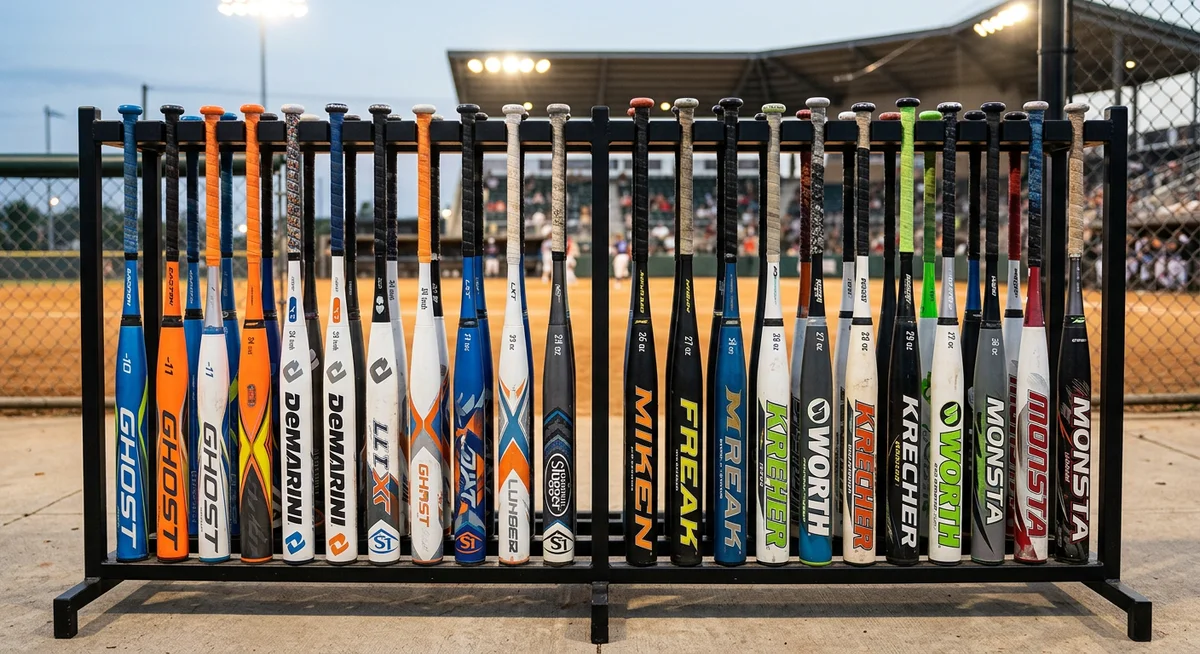
Bat drop is the number that separates a bat your swing can handle from a bat that slows you down. The wrong drop costs you contact rate, bat speed, or both. This guide breaks down fastpitch drop weights (-8 through -13), slowpitch weight selection, and routes you to the right starting point based on how you actually hit.
What Is Bat Drop?
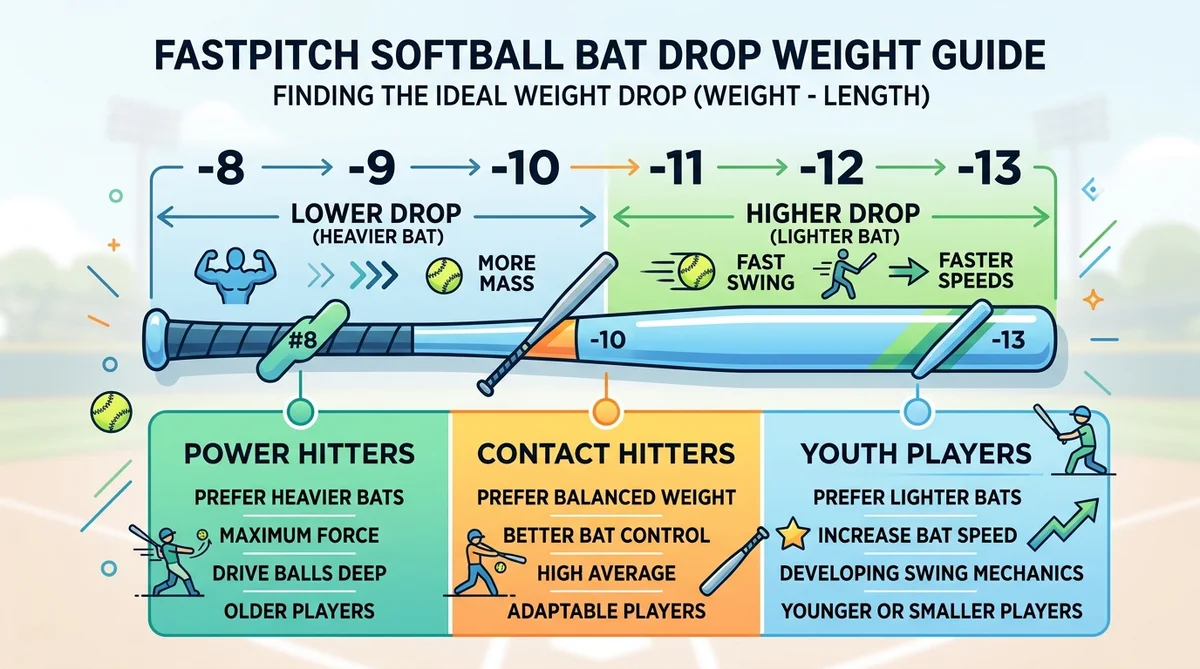
Bat drop = bat length minus bat weight. A 34″ bat that weighs 24oz is a -10 drop. A 33″ bat at 22oz is also -11. The number is always expressed as a negative. Smaller number (closer to 0) = heavier bat relative to length. Larger number (more negative) = lighter bat relative to length.
Quick formula: Drop = Length (inches) − Weight (oz). A 34″ / 24oz bat = -10. A 33″ / 22oz bat = -11.
Fastpitch bats follow this drop system. A -10 is the most common competitive drop across high school and college. Slowpitch bats don’t use the drop system — they’re compared by actual weight in ounces (26oz, 27oz, 28oz). Both covered below.
Fastpitch Bat Drop — Full Breakdown
| Drop | Best For | Level |
|---|---|---|
| -13 | Youth beginners — maximum bat speed | 8U–10U |
| -12 | Youth, slappers — fast and forgiving | 10U–12U |
| -11 | Developing players, contact hitters | 10U–14U |
| -10 | Most competitive players — balanced | 12U–adult |
| -9 | Power transition — needs proven bat speed | High school–adult |
| -8 | Elite power hitters — max mass at contact | College–adult |
-12 to -13: Youth and Beginners
Lighter bats = faster swing speed. For 8U–10U players and beginners learning to make contact, starting at -12 or -13 lets them develop swing mechanics without fighting bat weight. Contact rate matters more than power at this stage. A player who makes solid contact with a -12 hits the ball harder than a player who struggles through the zone with a -10.
-11: The Youth-to-Competitive Transition
Standard for 10U–12U competitive play and the right starting drop for contact-focused players at any age. Fast enough to work the outside pitch, heavy enough to carry balls to the gap. Adult rec-league returnees should start here before moving up.
-10: The Standard Competitive Drop
The most common fastpitch drop from 12U through adult competition. If you’ve been playing competitive fastpitch for more than a season and make consistent contact, -10 is your default starting point. Good balance of swing speed and mass at contact.
-9 and -8: Power Hitters Only
Every ounce of drop weight reduction requires more bat speed to maintain the same contact zone coverage. -9 and -8 are for players who have confirmed through game results — not practice tee work — that they have the bat speed to handle the extra mass. If exit velocity and contact rate hold at -9, the trade is worth it. If either drops, go back to -10.
Slowpitch Bat Weight Selection
Slowpitch bats don’t use the drop weight system. You choose by actual weight in ounces for a standard 34″ bat.
| Weight | Best For |
|---|---|
| 26oz | Bat-speed-first hitters, contact/gap approach |
| 27oz | All-around rec league hitters (most popular) |
| 28oz | Power hitters with confirmed bat speed |
| 30oz | Tournament players — maximum momentum |
The principle is the same as fastpitch: bat speed beats bat mass when they conflict. A 28oz bat you can’t fully accelerate delivers less power than a 26oz bat you can. Start at 27oz, confirm you’re getting full acceleration through the zone, then move up if the gap shots aren’t carrying.
Common Mistakes
Buying too heavy. Feels powerful in the store, produces weaker contact on the field. If you’re regularly hitting the ball straight down or losing the outside pitch, the bat is too heavy for your current swing speed.
Using age as the only guide. Body size, strength, and experience matter more than age. A strong 12U player may use -10. A smaller 14U player may still need -11. Test before committing.
Ignoring construction. A -10 one-piece alloy feels heavier than a -10 two-piece composite because swing weight distribution differs — more mass near the barrel on one-piece. Same drop, different swing feel. See our softball bat buying guide →
Which Bat Drop Is Right for You?
For baseball drop weight logic, see our drop weight in baseball bats guide →
Frequently Asked Questions
What drop weight bat should I use for fastpitch softball?
-10 is the most common competitive drop and the right starting point for most high school and adult players. Youth players (10U–12U) typically start at -11 to -12. Power hitters who’ve confirmed their bat speed handles the extra mass move to -9 or -8. Contact hitters and slappers stay at -11 to -12 regardless of age.
Does bat drop matter for slowpitch softball?
Slowpitch bats don’t use the drop system — they’re compared by actual weight in ounces. The principle is the same: find the heaviest bat your swing can fully accelerate. Most adult rec league players use 26–27oz. Tournament power hitters use 27–28oz. 30oz is for players who’ve confirmed their bat speed supports that extra mass.
Can I use a baseball bat in softball?
No. Fastpitch and slowpitch bats are designed for different ball sizes and compression. Using a baseball bat in a softball league is a certification violation in most leagues and produces poor contact with the larger softball. Fastpitch bats are built for the 11″ or 12″ fastpitch ball. Slowpitch bats are built for the 12″ slow-speed ball.